


Business Valuation in the UAE: DCF vs Multiples
Publication date: 19.10.2026
Picking a valuation approach gets muddy fast when two advisors hand you two different price tags. For owners and backers operating in the Emirates, grasping how Discounted Cash Flow (DCF) and Market Multiples work is essential. Below we break down each one in plain terms, weigh their upsides and drawbacks, and show how local realities — taxation, thin market data — shape the final number. For the strategic angle on all this, read about business valuation in UAE.
Understanding Business Valuation Methods
Pinning down what a company is genuinely worth underpins any move to raise funding, sell up, or reorganize from within. Across Dubai’s fast-moving economy and the wider Emirates, a sound appraisal is what stops you from undercharging on an exit or overpaying on an acquisition.
It is common for two appraisers to land on different figures for one and the same company. The reason is that the techniques they lean on rest on distinct starting philosophies — one bets on where the business is headed, the other anchors to what the market says right now.
What is the Discounted Cash Flow (DCF) Method?
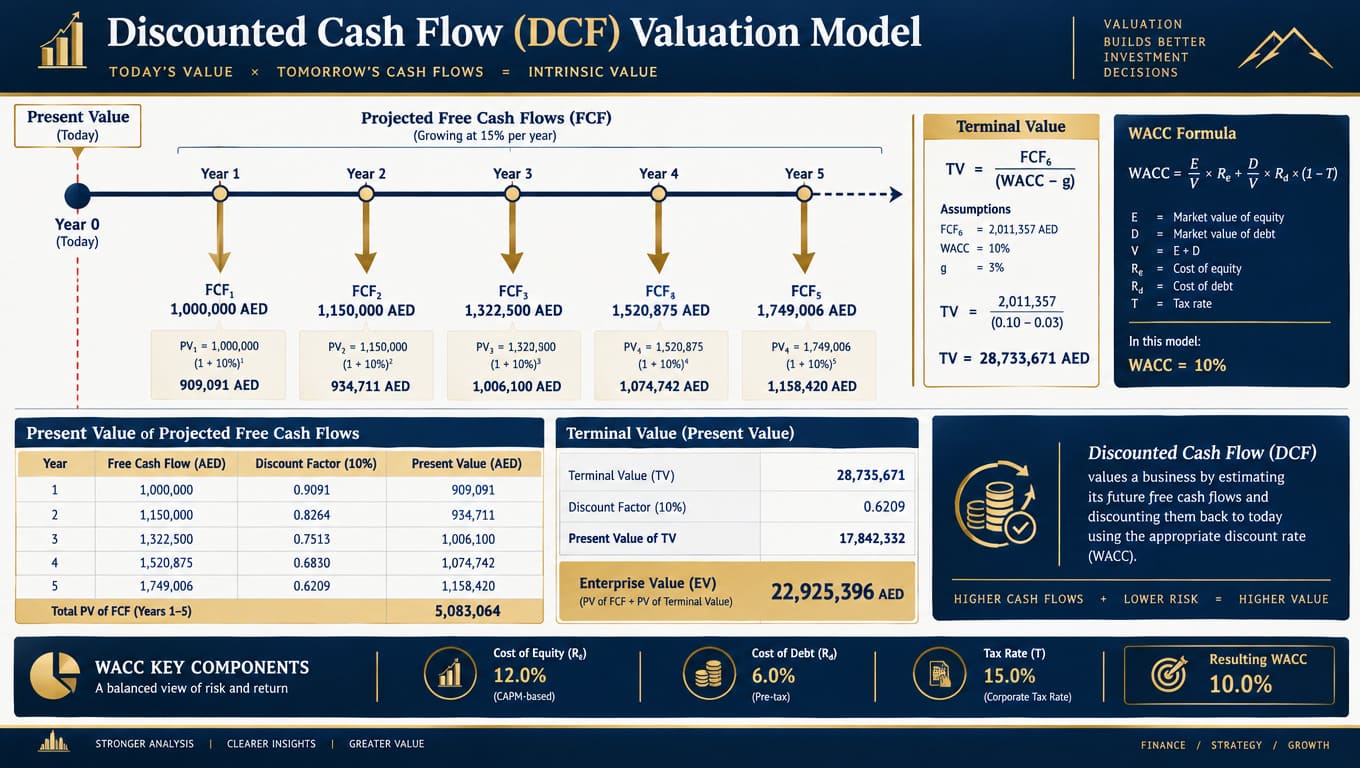
DCF rests on a plain idea: a company is worth the sum of the cash it will throw off down the line. Since a dirham earned next year counts for less than one earned today, each future inflow has to be scaled back to what it is worth in the present.
Building a credible model starts with a granular free cash flow projection spanning the coming three to five years. That projection folds in expected revenue, running costs, taxes, and shifts in working capital.
From there comes the WACC calculation — the Weighted Average Cost of Capital — which sets the discount rate. This figure captures the particular risks tied to running the operation inside the Emirati market.
Take a company projected to throw off a steady 1,000,000 AED of free cash flow each year over five years, with the discount rate worked out at 10%. The present value of that stream lands near 3,790,000 AED, not the plain sum of 5,000,000 AED.
What Are Market Multiples?
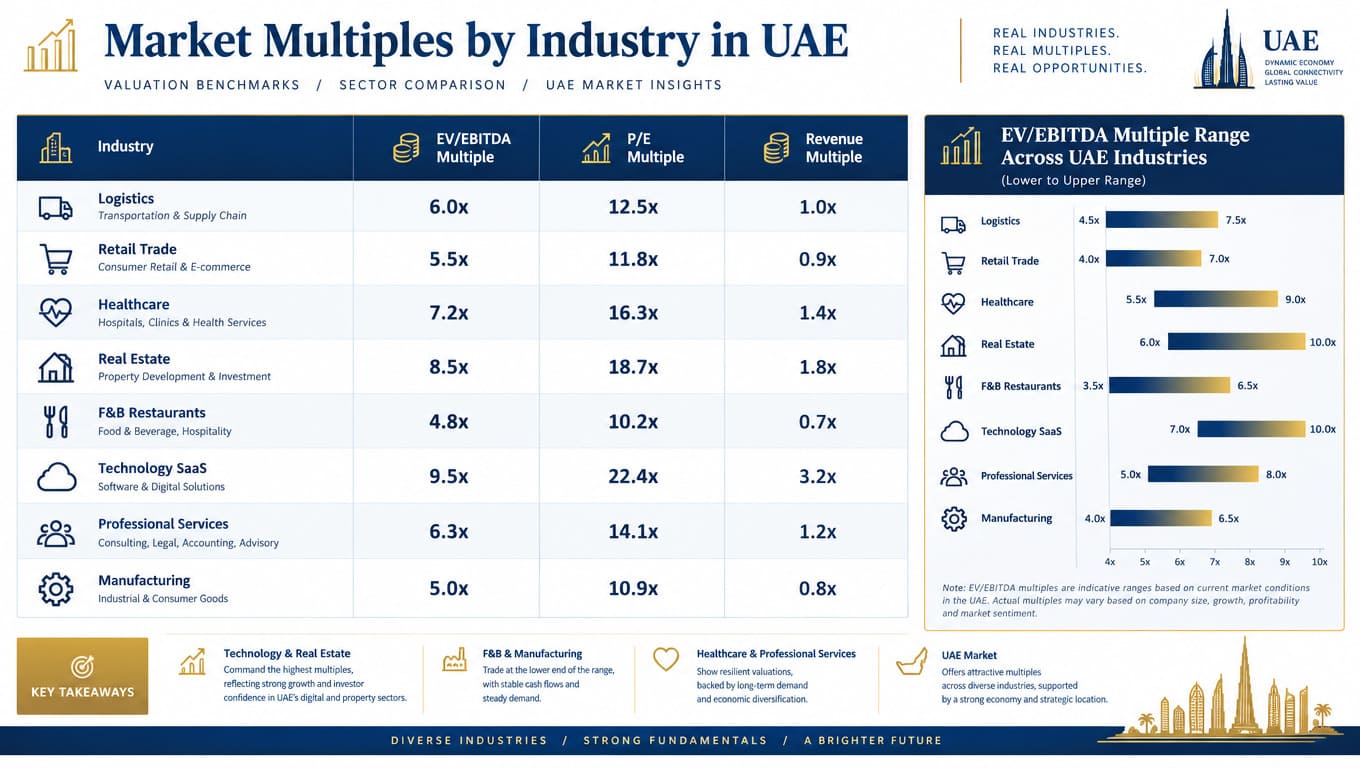
This technique prices a company by holding it up against comparable firms sold recently or trading on public exchanges. The logic mirrors how an apartment gets valued off the back of recent sales in the very same building.
Rather than modeling cash flows years out, it draws on either a comparable company analysis or a review of precedent transactions. You study the financials of similar businesses to pin down the going rate for the sector.
The metrics that surface most often are the EV/EBITDA multiple — Enterprise Value against Earnings Before Interest, Taxes, Depreciation, and Amortization — and the revenue multiple.
Say comparable logistics firms in Dubai change hands at roughly 6x EV/EBITDA, and your own logistics operation posts EBITDA of 2,000,000 AED. That puts your indicative worth at 12,000,000 AED.
When to Use DCF and When to Use Market Multiples
Which route to take hinges on a few things: how reliably you can forecast revenue, how much capital your operation eats up, and whether solid market data is actually available. No single method covers every situation cleanly.
DCF shines for capital-heavy, steady businesses with dependable earnings, and equally for young startups brimming with growth prospects but not yet turning a profit. It is also what you reach for when a bank or an institutional fund wants a figure you can defend in depth.
Multiples come into their own for a fast, grounded read on a company in a mature sector where comparable deal data is plentiful. They prove especially handy when long-range forecasts are shaky or simply cannot be built with any confidence.
For a reading fine-tuned to your particular sector, the smart move is to draw on professional business valuation services that blend both techniques to good effect.
Regional Specifics Affecting Valuation in UAE
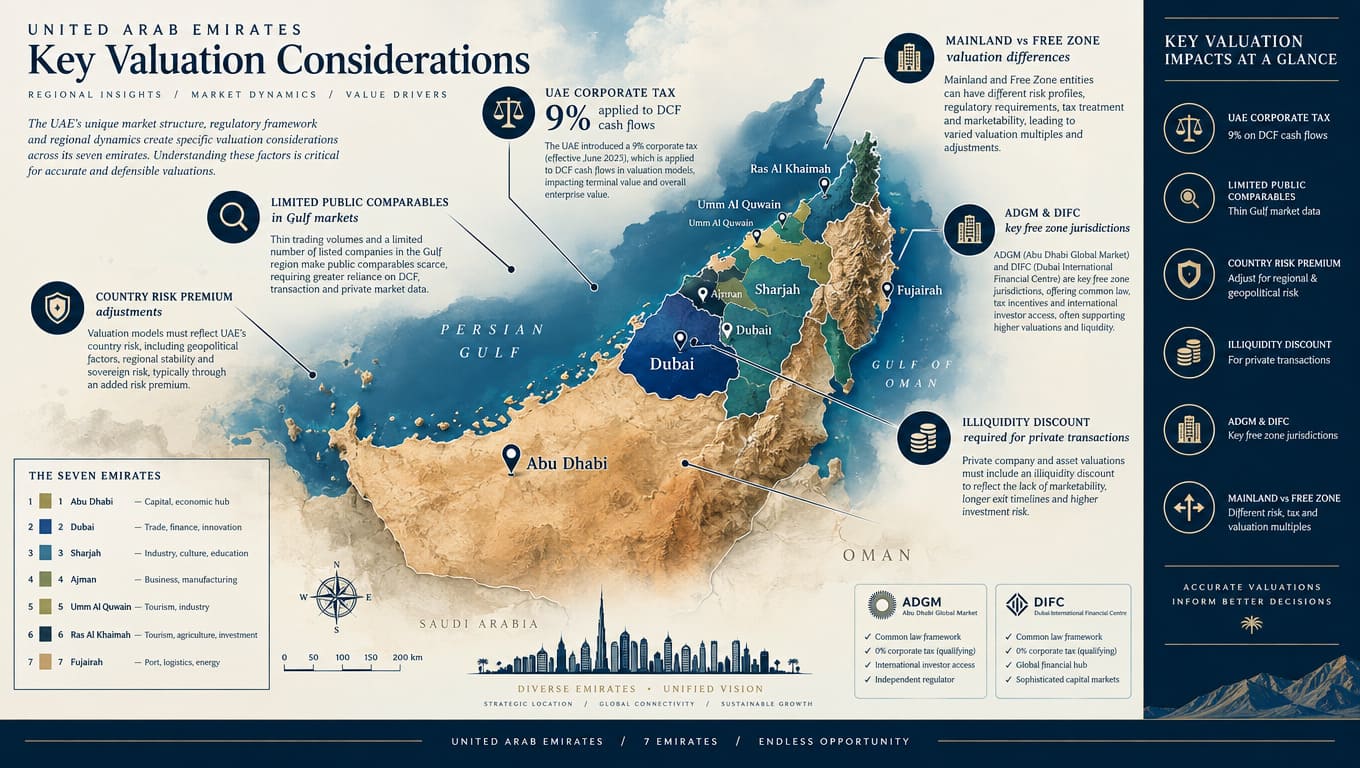
Running an appraisal on the local stage calls for a handful of specific tweaks. The 9% corporate tax brought in recently, for one, now has to flow through every cash flow projection, feeding straight into the bottom-line net income.
A further hurdle is how few publicly listed peers exist across the Gulf. That shortage turns a clean comparable company analysis into a thornier exercise than it would be in Western markets.
Because private sale data stays largely hidden, local specialists have to layer on deliberate adjustments for country risk, company size, and illiquidity to square their results with international standards. Any sound appraisal in Dubai has to reckon with these local quirks.
Pros and Cons of Each Method
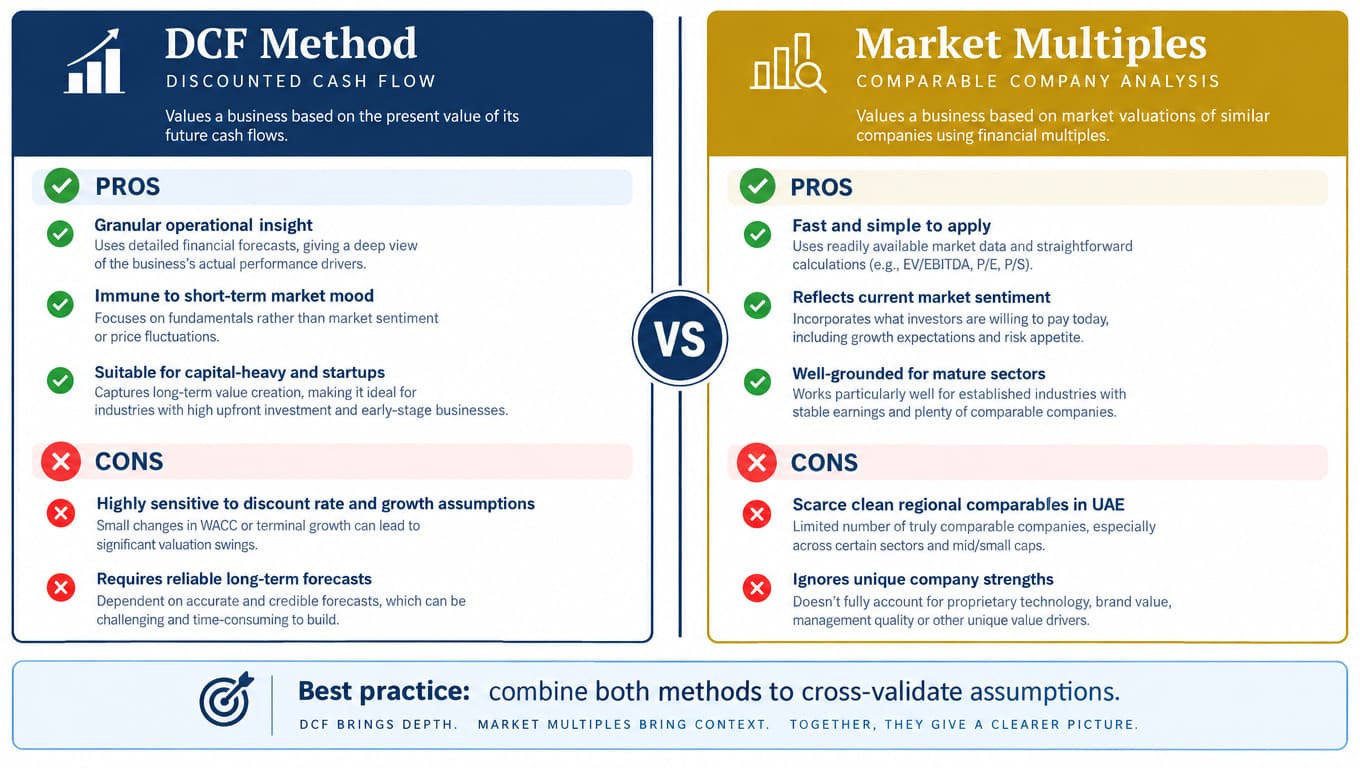
Every model carries built-in strengths and soft spots. Knowing them keeps you from making expensive analytical missteps once negotiations begin.
- DCF Pros: Granular by nature, it picks up the specific operational edge of your business and stays unmoved by passing market moods.
- DCF Cons: It reacts sharply to even minor shifts in the discount rate or the growth assumptions you feed it.
- Market Multiples Pros: Quick to run, easy to grasp, and in tune with what the market feels today.
- Market Multiples Cons: Clean regional comparables are hard to come by, and the method glosses over what makes a company unique.
Expert Advice: Never hang a verdict on one method alone. A dependable appraisal sets the income approach against the market approach to cross-check assumptions and settle on a realistic range.
How to Interpret Differences Between Methods
Seeing a DCF output and a multiples read land on different numbers is entirely normal. Yet once the gap between them pushes past 20–25%, backers start to treat it as a warning sign.
A yawning gap usually points to one of two things: the growth you penciled into the DCF is too rosy, or the multiples in play do not genuinely mirror the company’s niche.
Multiples also work as a sanity check on your DCF terminal value. If the DCF figure implies an exit multiple running at twice the sector norm, your long-range forecasts are due for a rethink.
Practical Tools for Choosing Your Valuation Method
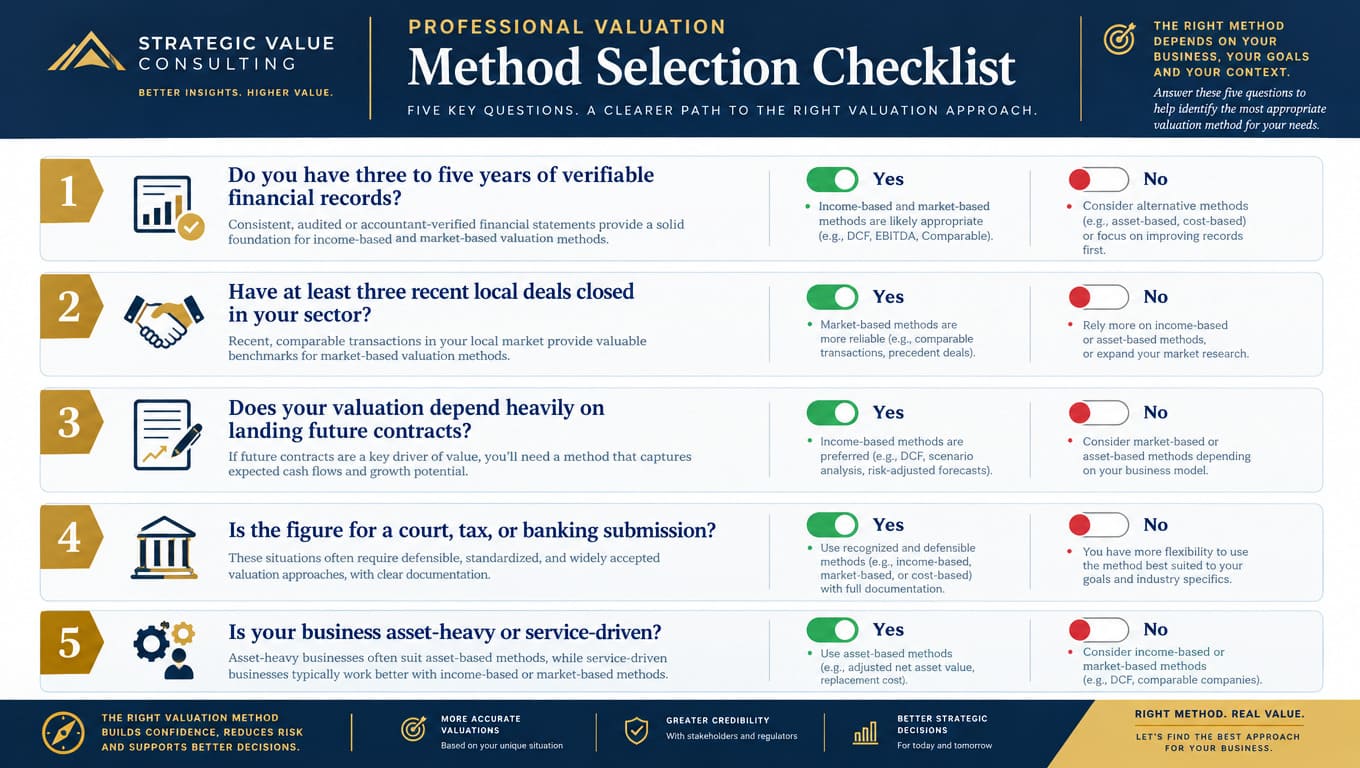
To settle on the right fit for where your business stands today, run through the core criteria in the selection guide below.
- Predictable Cash Flows: Lead with DCF and keep Multiples as a backup.
- Unique Tech Startup: Lean on DCF with scenario analysis, since comparables are seldom around.
- Standard Trading/Retail: Put Multiples first and use DCF to confirm.
- Asset-Heavy Industry: Pair DCF with asset-based approaches.
Before you lock in a choice, work through this short checklist:
- Can you point to three to five years of verifiable financial records?
- Have at least three recent local deals closed in your sector?
- Does your model hang heavily on landing future contracts?
- Is the figure destined for a formal court, tax, or banking procedure?
Invitation to Professional Valuation and Consultation
Working out what an enterprise is worth across the Gulf demands real financial depth paired with on-the-ground market feel. A miscalculated number can sink a deal or bleed value when the bargaining starts.
Our investment and advisory practice delivers a thorough, independent valuation report built around the economic facts of Dubai and the Emirates. Whether you are gearing up for an M&A deal, courting investment, or mapping a strategic exit, we make sure the figure holds up.
Reach out to our specialists today to book a professional consultation and put a solid financial footing under your next corporate move.
Frequently Asked Questions
Can Western industry multiples be used to value a company in Dubai?
Applying Western multiples as-is is not advisable. With public data scarce in the Emirates, specialists adapt foreign ratios and always build in discounts for country risk, the local market’s lower liquidity, and the particular scale of businesses operating here.
How has the introduction of corporate tax in the UAE affected DCF valuations?
The 9% corporate tax directly trims a company’s net cash flow. When a DCF model is built today, that tax has to sit inside the cash flow projection, which pulls the resulting present value below what it would have been in the tax-free era.
What should you do if DCF and multiples results differ by more than 25%?
A gap that wide is a warning sign. More often than not it means the growth baked into the DCF runs too optimistic, or the peer companies picked for comparison do not match your niche. The terminal value assumptions or the chosen multiples need to be revisited.
Which valuation method suits a UAE tech startup with no current profit?
For an early-stage venture, multiples deliver little because there is no profit to anchor to. The priority here is a DCF built across several development scenarios, since it can capture future potential and the cash flows you expect down the line.
Why are multiples alone insufficient for formal M&A deals in the UAE?
Multiples reflect only the mood of the market at a moment and overlook a company’s distinctive operational strengths. To produce an independent report aligned with international standards, the income approach (DCF) and the market approach are always combined, so the data can be cross-checked and the figure defended before backers or banks.
Similar services




Recent Posts