

Valuing Asset-Light Startups in the UAE: Methods Guide
Publication date: 21.10.2026
Putting a number on an asset-light venture in the Emirates is tricky, since the usual asset-based formulas simply fall flat. What your company is actually worth sits in its people, its product, its name, and its data — not in anything you can touch. This guide walks through the valuation techniques built for SaaS, fintech, and marketplace models, with a local lens throughout. Learn more about preparing for investors so your paperwork lines up with the figure you are aiming for.
Why Traditional Asset-Based Valuation Doesn’t Work for Asset-Light Startups
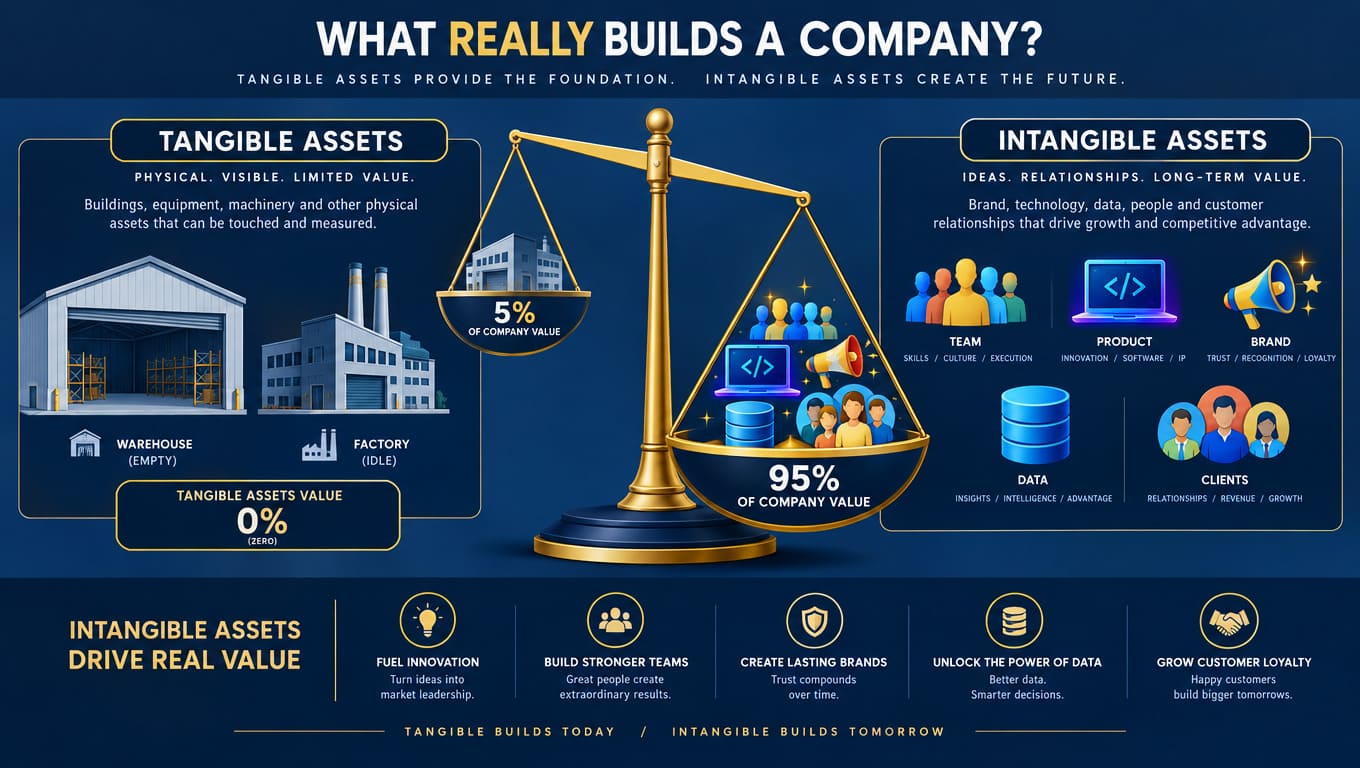
Try pricing a SaaS platform or an online marketplace off its tangible holdings, and the balance sheet will read near zero. Where factories or property anchor industrial firms, asset-light companies spin value out of intellectual capital instead. Classic book value quietly skips over the very things driving your success.
Your real worth rests on intangibles:
- The Team: Skilled engineers, founders with a clear vision, and a feel for the local market.
- The Product: In-house code, distinctive algorithms, and the way the experience is designed.
- The Brand: Visibility and standing within the Dubai or Abu Dhabi ecosystems.
- Data and Clients: What you know about user behavior, plus a steadily expanding base of loyal customers.
Key Factors Influencing the Valuation of Asset-Light Startups
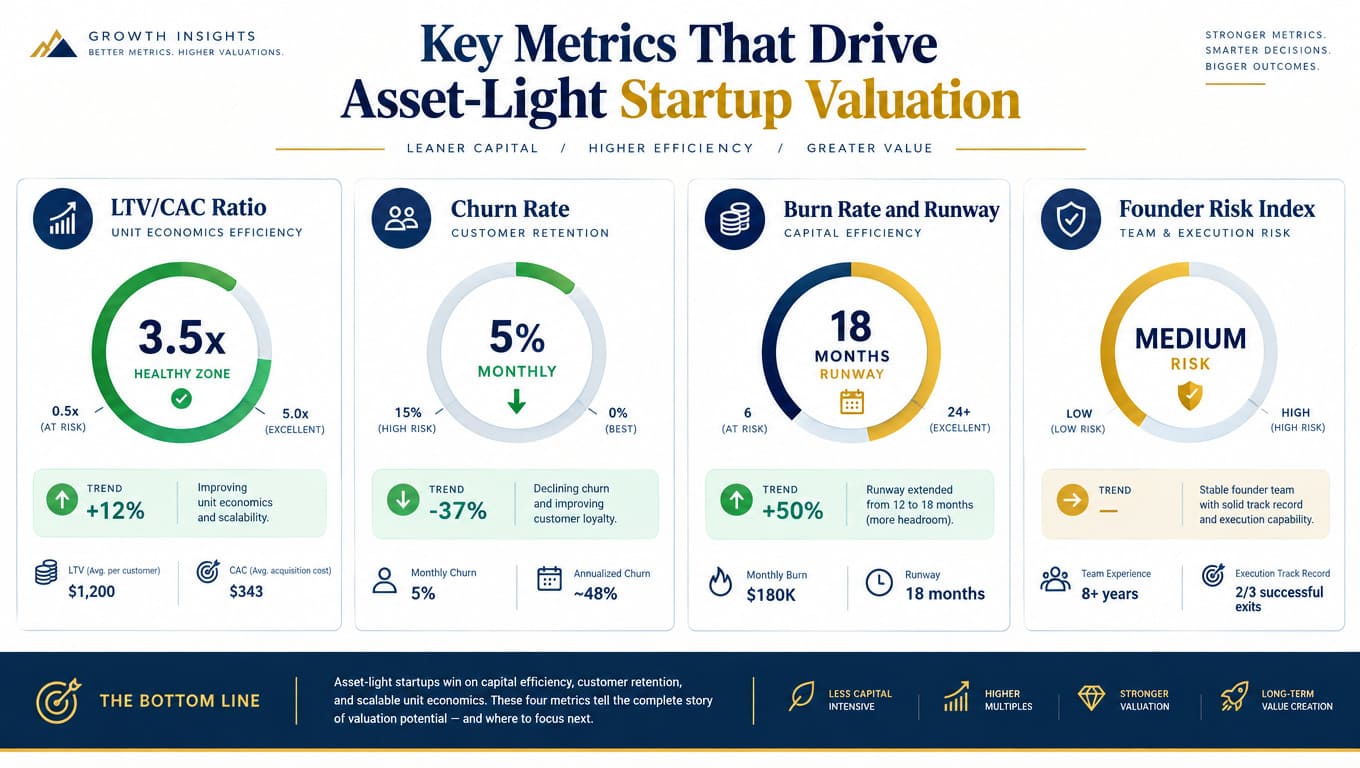
To arrive at a fair figure, backers study unit economics and how lean your operation runs rather than any shop floor. You have to show a firm handle on your numbers. Rapid growth is taken as given, but it is the caliber of that growth that shapes what your company can command.
The metrics that genuinely shift the figure include:
- LTV/CAC Ratio: What a customer is worth set against what it costs to win them.
- Churn Rate and Retention: Evidence the product sticks and tackles a real problem.
- Burn Rate and Runway: How tightly you are deploying capital as you scale.
- Founder Risk: Whether the business keeps running once the original founders step back.
Intellectual property carries real weight in the final number. Make sure every line of code, trademark, and data right is legally held by the company entity itself. This matters all the more when you run market research services to prove out your competitive edge.
Main Startup Valuation Methods for Asset-Light Companies in the UAE
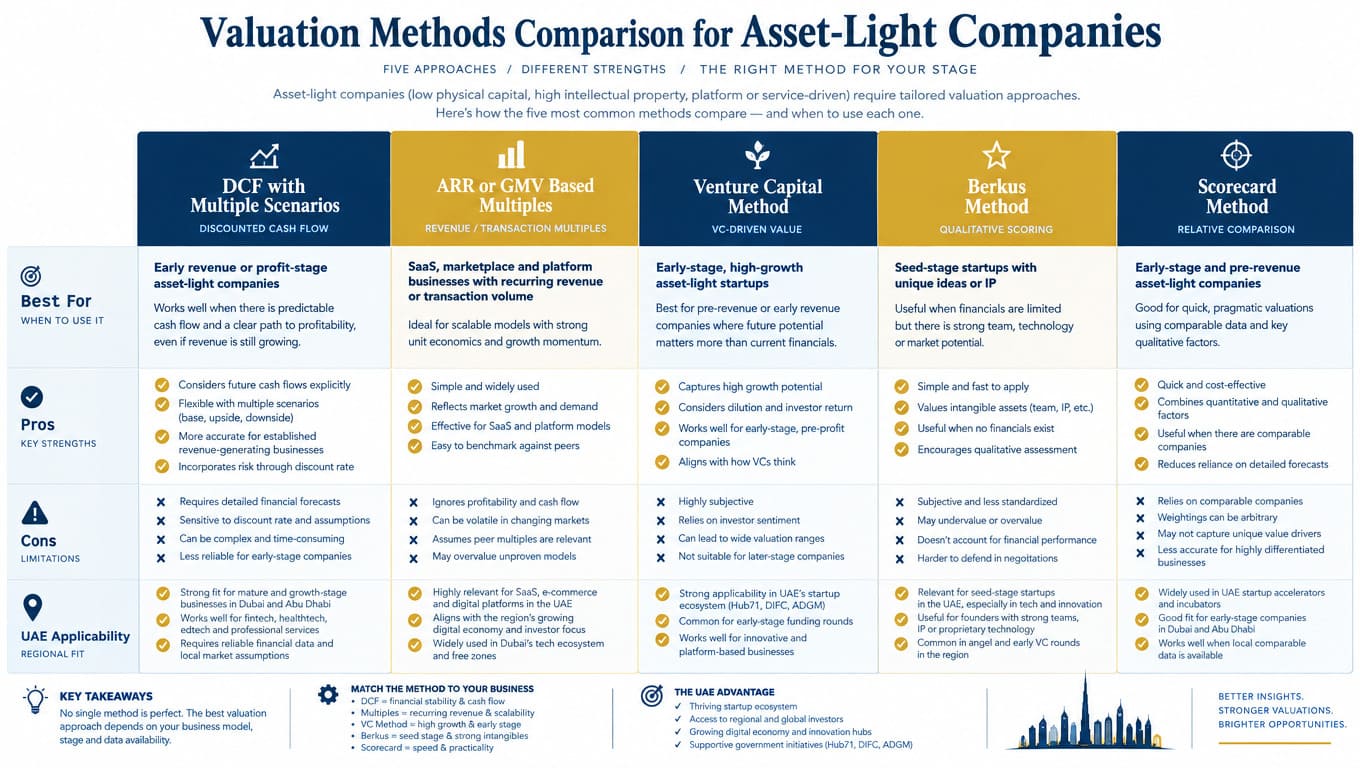
Discounted Cash Flow (DCF) with Multiple Scenarios
DCF comes into play once your venture shows steady revenue and growth you can forecast. It brings future cash flows back to their present worth. Locally, the 9% corporate tax has to sit inside those projections. Our advice is to map out three versions — conservative, base, and aggressive — so backers see a grounded spread rather than a single optimistic line.
Multiples Based on ARR or GMV
For SaaS platforms and marketplaces, this is the go-to route. You apply an ARR-based multiple drawn from sector norms. The trap is lifting US or European multiples wholesale. Conditions across the region usually call for tweaks that reflect market size and thinner local liquidity.
Venture Capital Method
Here backers reason backward from an expected exit value — an IPO or a buyout five to seven years out, say. They derive the post-money figure from the return they need to hit. The whole calculation leans on what the shares will be worth at the point of exit.
Berkus and Scorecard Methods for Pre-Revenue Startups
If launch is still ahead of you, the Berkus method attaches value to qualitative milestones such as the strength of the management or a working prototype. The Scorecard method, by contrast, measures your venture against regional peers to tune a baseline pre-money figure.
When the round carries high stakes, leaning on professional business valuation services keeps your numbers intact under institutional scrutiny.
UAE-Specific Considerations in Startup Valuation
The jurisdiction you register in moves the needle on your valuation. A venture based in the DIFC or ADGM tends to win greater backer confidence thanks to its common law footing. That makes the worth of your IP and brand sturdier and more enforceable than under certain onshore arrangements.
The 9% corporate tax now has to be woven into your financial models from the outset. On top of that, the shortage of public regional benchmarks means you need a deft hand at reshaping global SaaS multiples to fit the local picture. Backers here often want a quicker route to profit than their Silicon Valley counterparts do.
Common Pitfalls: Overvaluation and Its Consequences
Founders routinely mix up the “price” a backer will stump up with the company’s genuine “value.” Pinning an inflated figure on your seed round can boomerang into a down round down the line, where you end up selling shares cheaper and swallowing heavy dilution.
Expert Advice: An inflated valuation may feel like a victory now, yet it can strip you of control in later rounds if you miss the aggressive targets it locks you into.
Preparing for Your Valuation Discussion: A Checklist
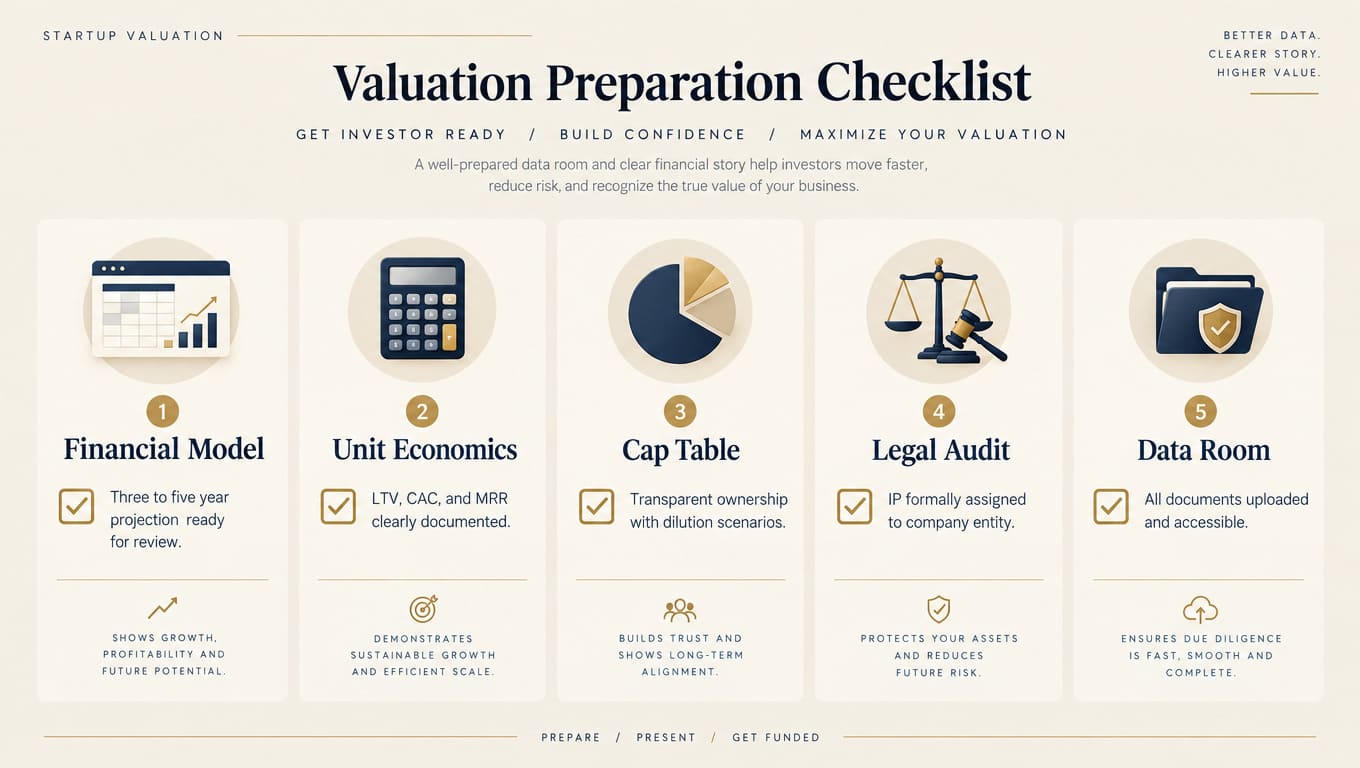
Before you walk into the room, the data has to be in order. Backers across the Emirates grow sharper by the year and expect polished reporting. Run through this list to get ready:
- Financial Model: A thorough three-to-five-year projection, built for backers to pick apart.
- Unit Economics: Clean figures on LTV, CAC, and monthly recurring revenue (MRR).
- Cap Table: An open view of who owns what and where dilution could land.
- Legal Audit: Proof the IP belongs to the company rather than the founders personally.

Done right, raising startup funding in the UAE strikes a balance between a compelling story and hard evidence.
How AserCapital Can Help You with Valuation and Fundraising
Working through asset-light valuation takes a blend of worldwide know-how and a read on the local market. AserCapital stands behind founders set on scaling across the region, from fixing a fair pre-money figure to keeping your cap table in shape, so you are ready at every turn.
We provide dedicated startup fundraising support to pair you with the right backers and land the capital you need on terms that work. Reach out today for a professional valuation consultation and move your growth story forward.
Frequently Asked Questions
How does a UAE Free Zone jurisdiction affect a startup’s valuation?
Setting up in a zone such as the DIFC or ADGM lifts backer confidence through its English common law base. That shields your intellectual property and keeps the ownership structure transparent, which can earn a stronger valuation than some onshore companies manage.
How does the UAE corporate tax feed into the DCF method?
The 9% corporate tax trims net cash flows in every future period. When you value a company by discounting those flows, the tax burden has to be built into the model from the start; leave it out and the result comes back overstated.
Can US-market ARR multiples be used to value a business in Dubai?
Copying Western multiples across is a mistake. The regional market runs on thinner liquidity and a different scale, so global multiples need reshaping to suit the local setting. Backers here more often press for a faster path to profit.
What can a pre-revenue startup in the UAE do to justify its worth?
Pre-revenue ventures lean on qualitative techniques such as the Berkus method or a scorecard approach. The figure rests on the team’s track record, whether a product prototype exists, how far risk has been reduced, and a comparison with similar startups across the region.
What are the risks of artificially inflating a company’s worth at the seed round?
An inflated seed figure sets a bar that proves hard to hold. Should the venture miss its aggressive goals, the next round closes at a lower price — a down round — which severely dilutes the founders’ stakes and loosens their grip on the business.
How do UAE investors verify intangible assets like IP and brand before a deal?
Backers run a rigorous legal review. For the intellectual property to count toward the company’s worth, every patent, trademark, and code right must be formally registered under the startup’s legal entity rather than the individual founders.
Similar services




Recent Posts