


Buying a Business in Dubai: Due Diligence Checklist
Publication date: 02.11.2026
Investors who plan to buy a business in Dubai gain immediate access to a thriving market, established cash flows, and an existing customer base. However, purchasing an operating company involves hidden risks that require thorough verification. This article provides a comprehensive due diligence checklist and explores the critical steps every investor must take to uncover potential pitfalls.
Strategic Advantages of Dubai M&A: Why Acquisition Beats Starting from Scratch
Acquiring an existing enterprise offers several strategic advantages over building a company from the ground up:
- Immediate cash flow generated from established sales channels and recurring client contracts.
- Ready-to-use infrastructure including active corporate bank accounts, which normally take 2–4 months to open for new entities in the UAE.
- Trained personnel who already understand local market specifics and regulatory requirements.
- Active trade licenses and regulatory approvals without waiting for initial government clearances.
Despite these benefits, an acquisition carries the risk of inheriting historical problems, such as tax penalties, labor disputes, or inflated financial metrics. A structured verification process uncovers these issues before you sign the final binding agreement. A professional mergers and acquisitions advisory can steer this process end to end.
Legal Due Diligence: Verifying Licenses, Approvals, and Litigation History
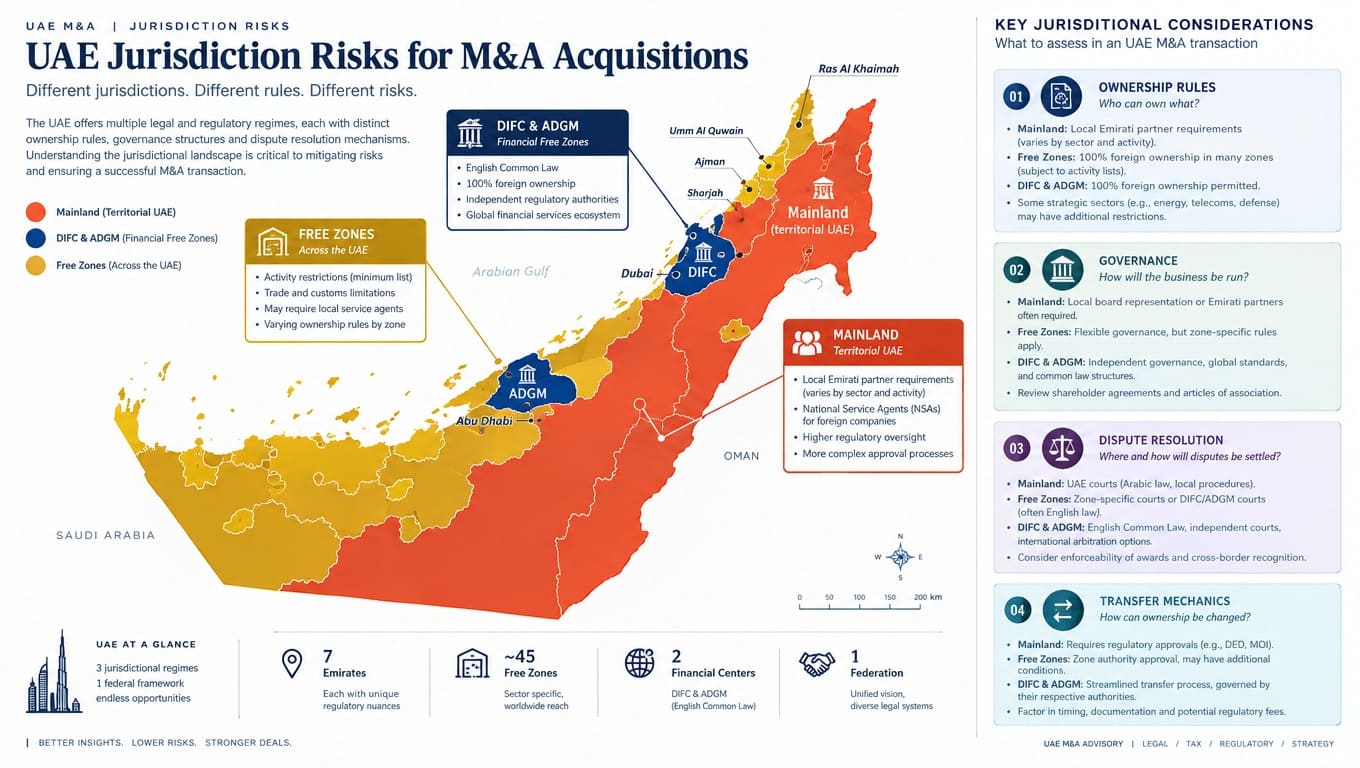
The UAE legal system comprises Mainland jurisdictions, over 40 Free Zones, and Common Law financial centers (DIFC and ADGM). Each framework enforces specific rules regarding ownership, governance, and commercial activities. Legal verification ensures the target company operates lawfully and possesses the legal right to transfer ownership.
Trade Licenses & Activities
The Commercial License issued by the Department of Economy and Tourism (DET) or the Free Zone Authority must be active. The company’s actual operations must strictly match the activities listed on the license (e.g., a consultancy cannot engage in general trading).
Corporate Structure & Ownership
A thorough review of the Memorandum of Association (MoA), Articles of Association (AoA), and the shareholder register is required to confirm the seller’s legal authority to transfer shares. For Mainland companies, any side agreements or powers of attorney involving local Emirati partners or National Service Agents (NSA) must be evaluated to prevent future ownership claims.
Regulatory Compliance
The company must comply with Economic Substance Regulations (ESR) and maintain an accurate Ultimate Beneficial Owner (UBO) register. Non-compliance leads to heavy statutory fines ranging from AED 20,000 to AED 400,000.
Financial Due Diligence: Analyzing EBITDA Quality, Hidden Liabilities, and Tax Compliance
Small and medium-sized enterprises in the region often maintain informal accounting practices, mixing personal expenses of the owners with corporate funds. Financial verification separates actual operational performance from accounting manipulations and supports an accurate business valuation. Organized sellers maintain their financial records in a secure data room, which accelerates the audit process and establishes credibility from the start.
Quality of Earnings and Working Capital
Earnings Quality and Cash Flow Verification
Reconstructing profit and loss statements helps determine normalized EBITDA by removing one-time revenues, non-operating income, and owner-related expenses that terminate post-transaction. Reconciling reported revenue with bank statements, POS terminal records, and invoices confirms the authenticity of the company’s cash flow.
Working Capital and Asset Integrity
Working capital analysis focuses on inventory and accounts receivable, which frequently see 90–180 day payment cycles in the Middle East. Receivables overdue by more than six months carry a high risk of becoming bad debt and requiring write-offs. Physical inventory inspections identify obsolete or slow-moving stock that artificially inflates the balance sheet.
Hidden Liabilities and Tax Compliance
Tax Regulations and Historical Audits
The UAE enforces a 5% Value Added Tax (VAT) and a 9% Corporate Tax. Because the Federal Tax Authority (FTA) imposes heavy penalties for late registration, incorrect filings, or missing documentation, strict compliance with VAT UAE regulations and historical tax returns is essential. Evaluating this compliance alongside structural readiness for Corporate Tax helps shield investors from post-acquisition audits and unexpected statutory fines.
Unrecorded Commitments and Financial Risk Assessment
Protecting investment capital requires a thorough investigation into unrecorded liabilities that may be omitted from standard accounting ledgers. Critical areas of review include:
- Post-dated checks. Validating unmapped checks issued to landlords or suppliers.
- Related-party transactions. Checking for subsidized goods or services that distort profitability.
- Credit facilities. Identifying active bank guarantees, loans, or asset pledges that restrict ownership transfer.
- Accrued liabilities. Calculating unpaid DEWA utility bills, municipal fees, and customs duties.
Identifying these discrepancies allows the investor to accurately adjust the purchase price or demand full debt settlement before closing the transaction.
Operational Due Diligence: Employee Contracts, Lease Agreements, and Suppliers
Human Resources and End-of-Service Benefits
UAE labor law entitles employees to an End-of-Service Benefit (EOSB) calculated on their basic salary and years of service. Since many local companies do not maintain separate cash reserves for these future payouts, share acquisitions mean inheriting the total accumulated gratuity liability. Calculating the exact EOSB liability down to the dirham allows for an accurate deduction from the transaction value. Additionally, operational reviews must verify employee management systems:
- WPS Compliance. Ensuring full adherence to the Wage Protection System for timely salary distributions.
- Emiratisation Quotas. Verifying compliance with mandatory hiring quotas for UAE nationals, as non-compliance freezes work visa issuance and triggers substantial monthly fines.
Commercial Leases and Supplier Integrity
Physical location is a primary revenue driver for retail, hospitality, and manufacturing businesses. Analyzing critical agreements maintains the stability of the company’s real estate and supply chain:
- Ejari Verification. Checking commercial leases in the Ejari system for clauses that grant landlords the right to increase rent or terminate contracts upon a change in company ownership.
- Landlord NOCs. Identifying administrative fees required to secure a No Objection Certificate (NOC) for the lease transfer.
- Supply Chain Audits. Checking registration codes with Dubai Customs and evaluating exclusivity agreements with foreign manufacturers.
- Vendor Credit Terms. Verifying whether current credit terms depend on corporate history or the personal reputation of the outgoing owner.
Addressing these real estate and supply chain vulnerabilities before closing prevents operational disruptions and allows the buyer to secure favorable terms in the final purchase agreement.
Technical Due Diligence: IP Rights and Technology Stack Health in the UAE
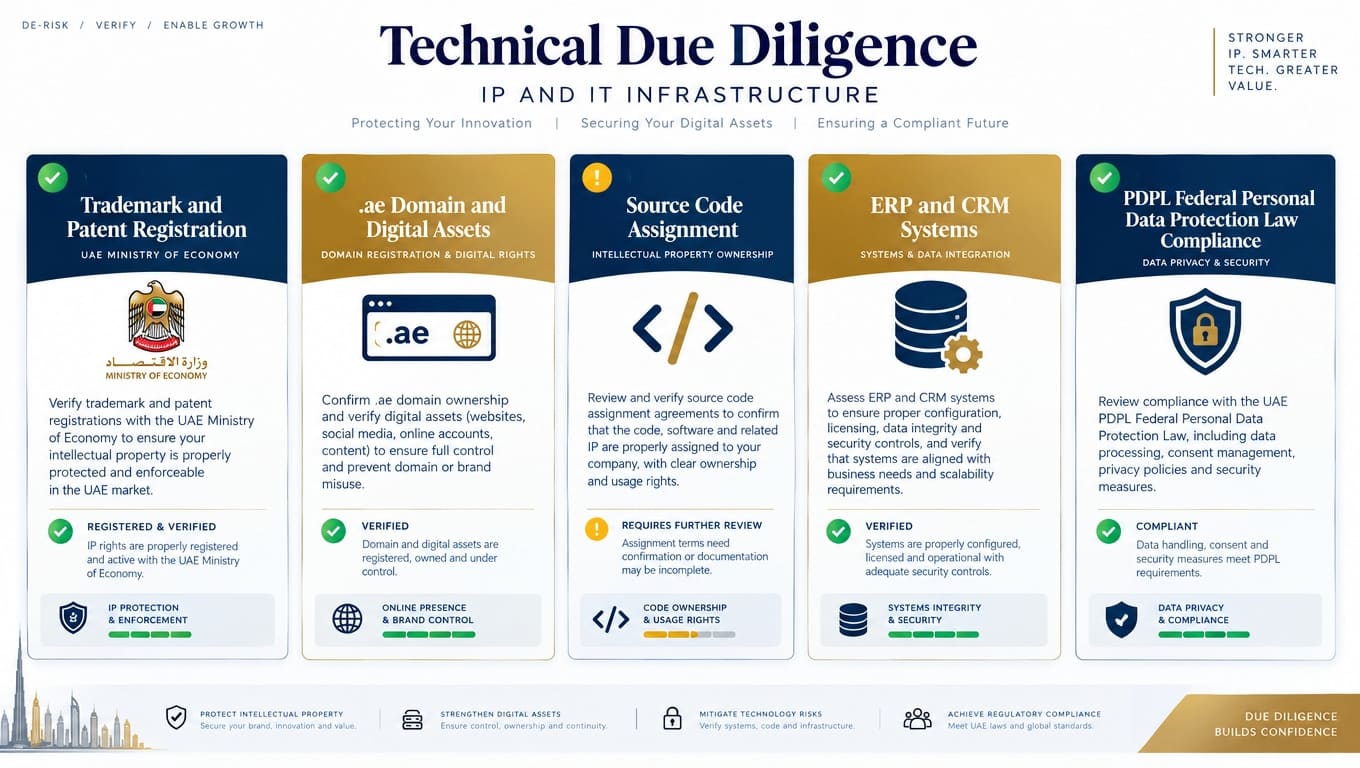
A trade name registered with the Department of Economy and Tourism does not guarantee trademark protection. Securing a brand across the UAE requires trademark registration with the UAE Ministry of Economy. Verifying the validity and ownership of trademarks, patents, and industrial designs prevents post-acquisition ownership disputes.
Additionally, administrative control over digital assets — including local .ae domains regulated by the TDRA, social media channels, and customer databases — must officially transfer to the buyer through formal assignment agreements at closing.
IT Infrastructure and Data Privacy
Evaluating software licenses, cloud hosting agreements, and ERP or CRM systems confirms the scalability and legal security of the technology stack. When software, mobile apps, or websites are built by external contractors, reviewing the original development contracts confirms that source code and intellectual property rights were fully transferred to the target company. Compliance with the UAE Federal Personal Data Protection Law (PDPL) and sector-specific data security standards is mandatory to avoid regulatory sanctions and reputational damage.
The Deal Structure: Asset Purchase vs. Share Purchase Agreements
Share Purchase Agreement (SPA)
Buying the shares of a legal entity keeps the corporate structure intact. The company retains its trade license, bank accounts, client contracts, employees, and lease agreements, ensuring a smooth transition.
However, the buyer assumes all historical liabilities, including unreported tax debts, pending lawsuits, and employee gratuity obligations. To mitigate these risks, agreements must include detailed warranties and indemnities, frequently backed by holding a portion of the purchase price in an escrow account for 6–12 months.
Asset Purchase Agreement (APA)
Acquiring specific assets — such as equipment, inventory, brand names, and client databases — allows the buyer to leave the existing legal entity and its historical debts with the seller. Executing an APA requires the buyer to already own or register a UAE entity with an appropriate license to absorb these assets.
While this structure eliminates the risk of hidden liabilities, it demands more time and administrative effort to transfer employee visas, cancel and re-issue permits, and execute new contracts with landlords and suppliers.
How ASER Minimizes Risks: Professional M&A Advisory and Buy-Side Representation

Navigating an acquisition in a foreign jurisdiction requires an objective analysis of financial and operational structures. As an international investment consulting boutique, ASER operates as a specialized buy-side advisor. We focus on investment due diligence, business valuation, and financial analysis to protect investor capital from hidden pitfalls.
Partnering with ASER during transaction screening and validation delivers clear, actionable results:
- Early Risk Identification. Spotting financial deal-breakers and asset discrepancies early to save transaction costs and avoid unviable acquisitions.
- Price Optimization. Substantiating price reductions based on uncovered historical liabilities, bad debts, and unfunded employee benefit obligations.
- Valuation Integrity. Providing multi-methodology business and asset valuations to guarantee the final offer aligns with realistic earning quality and market positioning.
If you plan to acquire an operating company in the Emirates, protect your capital with objective data and professional oversight. Fill out the form — an ASER M&A advisor will contact you to discuss your investment targets and outline a tailored verification plan.
Similar services




Recent Posts